des-educación - de-schooling- actions- situations- encounters- ethos references
Monday, 2 July 2012
Monday, 28 May 2012
Saturday, 19 May 2012
VEN A LA ESCUELA DE CALOR ..........
"Enseñar a tener ideas ciertamente requiere bastante más que transmitir información. El profesor tiene que reubicarse y abandonar el monopolio del conocimiento para actuar como estímulo y catalizador, y tiene que poder escuchar y adaptarse a lo que escucha. Además, la generación de ideas y revelaciones es impredecible y por lo tanto corre el peligro constante de ser una actividad subversiva. Lo impredecible no siempre se acomoda al estatus quo. Dado que últimamente los gobiernos decretaron que subversión y terrorismo son sinónimos, ya nadie quiere generar subversión. Sin embargo, la subversión es la base de la expansión del conocimiento. Al expandir, lo subvierte." Luis Camnitzer
Thursday, 26 April 2012
Escuela de Calor at Club Natacio Barcelona /// Conocimiento versus Saber ///
El Club Natacion Barcelona donde se creo la Escuela de Calor en 2008...


Escuela de Calor, comenzó oficialmente el pasado verano 2 Julio 2011 como una serie de paseos y la creación de una Terraza Ready Made, durante el mercado de arquitectura con sede en Barcelona Eme3, aunque de hecho in-oficialmente puede decirse que comenzó unos veranos antes en Barcelona 2008 , visitando El Club Natacion Barcelona con amigos y percibiendo que era en esas situaciones en la playa y tomando un gin tonic al atardecer cuando un contexto muy especifico de mar azul , velas en el horizonte etc.. parecia facilitar o canalizar la comunicacion entre nosotros hacia un estado muy particular y claramente inspirado.
La idea detrás de Escuela de Calor es re-activar formas de encuentro en contextos y actividades que faciliten el intercambio de información y de saber , que hoy por hoy han sido relegadas en su funcion a lo estrictamente social y superficial , como el ocio o el networking.
De la misma forma que los ejercicios de improvisacion en la musica o la danza , facilitan la percepcion, la interaccion etc con vias a mejorar la performance , el contenido y la dinamica de lo que mas tarde pueda ser mostrado como obra acabada y formalizado.
Es una forma de encontrarse y no es una escuela donde hay un maestro que muestra lo que se debe saber y lo que no.
Se trata de otro asunto , se trata casi de un tipo de tiempo donde todo es posible, incluido el error y el juego...
????????????????////////////////////////////////////////??????????????????????????????////////////////////////////////////////////
School of Heat believes on certain philosophers angles about the management of Knowledge , here Michel de Montaigne has his say:
"Human understanding is marvellously enlightened by daily conversation with men, for we are, otherwise, compressed and heaped up in ourselves, and have our sight limited to the length of our own noses"
and as we can respect language we and Michel also know, it could be as Babelian as hell:
"The greater part of the world's troubles are due to questions of grammar"
Michel de Montaigne propone en materia educativa la entrada al saber por medio de ejemplos concretos y de experiencias antes que por conocimientos abstractos aceptados sin crítica alguna. Rehúsa, sin embargo, convertirse él mismo en un guía espiritual, en un maestro de pensamiento: no tiene una filosofía que defender por encima de las demás, considerando que la suya es únicamente una compañía en la búsqueda de identidad.
La libertad de pensamiento no se plantea como modelo, pues simplemente ofrece a los hombres la posibilidad de hacer emerger en ellos el poder de pensar y de asumir esta libertad:
«La que enseña a los hombres a morir como se aprende a vivir».
No podemos creer nuestros razonamientos porque los pensamientos nos aparecen sin acto volitivo; no los controlamos, no tenemos razón para sentirnos superiores a los animales. Nuestros ojos no perciben más que a través de nuestros conocimientos:
«Si preguntáis a la Filosofía de qué materia es el cielo y el sol, ¿qué os responderá ella sino de hierro o, con Anaxágoras, de piedra o tal estofa según nuestra costumbre? [...] Que plazca un día a la Naturaleza abrir su seno y hacernos ver propiamente los medios y guía de sus movimientos, y fijemos allí nuestros ojos! ¡Oh, Dios! ¡Qué desvíos, qué vacíos encontraríamos en nuestro pobre saber!»
Michel de Montaigne, Los Ensayos
Tuesday, 3 April 2012
John Baldessari, Teaching a Plant the Alphabet 1972
Teaching a Plant the Alphabet. Created as an exercise in futility, Teaching a Plant the Alphabet is an absurdist lesson in cognition and recognition. Known for creating the illogic from a logical construct and making nonsense from sense, this tape documents Baldessari’s response to Joseph Beuys’s influential performance, How to Explain Pictures to a Dead Hare. Baldessari’s approach here is characteristically subtle and ironic, involving ordinary objects and a seemingly banal task.
Monday, 2 April 2012
La enseñanza del arte como fraude* - Luis Camnitzer
Visto en [esferapública] Robado de http://salonkritik.net/
Quiero comenzar esto con dos afirmaciones pedantes y negativas. Una es que el proceso de educación de los artistas en el día de hoy es un fraude. La otra es que las definiciones que se utilizan hoy para el arte funcionan en contra de la gente y no a su favor.
La parte del fraude está en la consideración disciplinaria del arte, que lo define como un medio de producción. Esto lleva a dos errores:
El primer error es la confusión de la creación con la práctica de las artesanías que le dan cuerpo. El otro error es la promesa, por implicancia, que un diploma en arte conducirá a la posterior supervivencia económica.
La educación formal del artista sufre de las mismas nociones que imperan en las otras disciplinas: que la información técnica sirve para formar al profesional y que después de adquirir esta información uno podrá mantener una familia. En los Estados Unidos, en donde la educación no es un derecho sino un producto comercial de consumo, esta situación es llevada al nivel de caricatura obscena. La inversión económica para recibir el diploma final de maestría, el Master of Fine Arts, en una universidad decente es de unos 200.000 dólares. Al final de este gasto, la esperanza es vender la obra producida o enseñar a las generaciones venideras. Aun si esto no es literalmente así en otros países, el concepto probablemente funciona en todo el mundo.
En los 35 años que estuve enseñando a nivel universitario en los EEUU, probablemente tuve contacto con alrededor de 5000 estudiantes. De ellos calculo que un 10%, unos 500, tenían la esperanza de lograr el éxito a través de muestras en el circuito de galerías. Quizás una veintena de ellos lo haya logrado. Esto significa que 480 terminaron con la esperanza de vivir de la enseñaza. No sé cuantos lograron conseguir un puesto de profesor. Pero sí puedo sacar la cuenta que si 5000 estudiantes fueron necesarios para asegurar mi salario y luego mi bienvenida jubilación, esos 480 estudiantes necesitan una base estudiantil de 240.000 para sobrevivir. Y si seguimos el cálculo hacia las generaciones siguientes, rápidamente llegaremos al infinito.
La definición del arte es otro problema. Me gusta pensar que cuando se inventó el arte como la cosa que hoy aceptamos que es, no fue como un medio de producción sino como una forma de expandir el conocimiento. Me imagino que sucedió por accidente, que alguien formalizó una experiencia fenomenal que no encajaba en ninguna categoría conocida, y que eligieron la palabra “arte” para darle un nombre.
El problema que surgió al darle un nombre al arte es que nuestra profesión fue instantáneamente reificada — convertida en un objeto que ya no se puede cambiar. Desde ese momento en adelante ya no pudimos formalizar nuestras experiencias de lo desconocido, y en su lugar pasamos a intentar acomodar nuestra producción a esa palabra, la palabra arte. De esa manera lo que inicialmente había sido “arte como una actitud” pasó a ser “arte como una disciplina”, y peor aún, “arte como una forma de producción”. La forma, que inicialmente había sido una consecuencia de la necesidad de empacar una experiencia, ahora pasó a ocupar el lugar del producto.
Hace no mucho me encontré con una cita que ilustra el problema: “Cada palabra alguna vez fue un poema.” Es de Ralph Waldo Emerson, un autor a quien nunca le había puesto la más mínima atención porque, irónicamente, pensaba que solamente trabajaba con palabras.
El mercado capitalista nos enseña que si un objeto puede ser vendido como arte, es arte. Esta descripción, culturalmente cínica, obscurece una realidad mucho más profunda. Esta realidad es que el propietario del contexto último de la obra de arte determina su destino y su función. La propiedad del contexto, que es una de las formalizaciones del poder, es un hecho político. Esa propiedad es tan fuerte que incluso las manifestaciones que son y contienen material subversivos, son rápidamente comercializadas.
Esta comercialización subraya el hecho, aunque muchas veces negado, que la política sea una parte de la definición del arte. Y es como consecuencia de la propiedad del contexto y de esta negación, que la separación de arte y política en entidades discretas, no solamente es reaccionaria y una manera de limitar la libertad del artista, sino que también es una falacia teórica. De manera que sí, todo arte es político, y no, no todo el arte es lo que entendemos como “arte político”.
Arte político en cierta forma significa que subdividimos el pastel del conocimiento en tajadas de tajadas. En un número de la revistaArtforum, la artista norteamericana Andrea Fraser enfrentó estos problemas en una forma que me gustó mucho. Definió al arte político de una manera similar a la que yo definiría a todo el arte:
“…Una respuesta es que todo arte es político, el problema es que la mayoría (del arte) es reaccionaria, es decir, pasivamente afirmativo de las relaciones del poder bajo las cuales fue producido…Yo definiría al arte político como el arte que conscientemente se propone intervenir en las relaciones de poder (en lugar de solamente reflexionar sobre ellas), y esto significa necesariamente las relaciones de poder dentro de las cuales el arte existe. Y hay una condición más: Esta intervención tiene que ser el principio organizativo de la obra de arte en todos sus aspectos, no solamente en su “forma” y su “contenido”, sino también en su forma de producción y de circulación.” i
Se puede afirmar que la enseñaza del arte se dedica fundamentalmente a la enseñanza sobre como hacer productos y como funcionar como artista, en lugar de cómo revelar cosas. Es como decir que enfatizamos la caligrafía por encima de los temas sobre los cuales queremos escribir y como vender esas páginas caligrafiadas. Y con ello, bajo el disfraz de lo apolítico o de una política consumida instantáneamente, servimos a una estructura de poder que es totalmente política.
Para peor, enseñar a fabricar productos es algo fácil y cómodo, y por lo pronto una situación en la que se puede caer, quedar y sentirse bien. Pero la información para esta enseñanza es algo existente y es transmitida. Y los procesos de transmisión de información existente se acomodan al modelo de la pedagogía autoritaria. Como ya lo dijo Paulo Freire, el profesor es similar al bancario que tiene y distribuye el dinero de acuerdo a sus criterios. En el salón de clase este dinero es la información. Con esta relación de poder se minimiza toda posibilidad de rebelión.
Para lubricar mejor el proceso en el campo de la enseñanza artística, se declara la imposibilidad de enseñar el como tener ideas. Si el alumno no tiene ideas, es culpa del alumno. Esta negación y culpabilización solamente es posible si uno clasifica a la gente en dos categorías: en genios y en imbéciles. Se elimina la categoría de “normal”. En cierta forma esto presume en mi ejemplo de los 500 estudiantes de los cuales 20 lograron ingresar al circuito de galerías, que estos 20 son los genios y que los otros 480 que piensan en enseñar arte son imbéciles. Y esto explica por que en los Estados Unidos las universidades tratan de contratar como profesores a las estrellas del mercado artístico, no importa cuan malos son como enseñantes.
De hecho, la ideología de esta clasificación va mucho más allá y es bastante cínica con respecto a los resultados. La presunción verdadera que subyace todo esto es que el arte no se puede enseñar. De acuerdo a esta idea, el proceso educacional no es más que un cedazo o filtro que sirve para identificar a los genios, los cuales con suerte emergen gracias a sus facultades personales. La facilitación de esta emergencia de genios era una de las intenciones de la Bauhaus cuando se diseñó el famoso curso de fundación básica. El curso fue luego adoptado por infinidad de instituciones que se consideraron progresistas y modernas. Y no era que los ejercicios fueran malos, era la ideología la que fallaba. La moraleja de todo esto es que los 200.000 dólares en los estudios en Estados Unidos se invierten en el derecho de ser filtrado para dejar lugar a los genios. Las mejores universidades entonces son las que atraen y filtran más genios. Como esos genios en realidad no necesitan de las universidades, éstas venden la fama de sus diplomas y una pedagogía haragana.
Mirando el peor de los casos, se podría justificar el proceso diciendo que aquellos que no logran pasar por el filtro por lo menos aprenden a apreciar y a consumir el arte. Cosa que significa que la carrera del arte está en la situación privilegiada de simultáneamente crear a los productores y a su mercado. Es como educar médicos, pero en donde con la misma inversión de dinero, aquellos que no logran graduarse terminan siendo educados para enfermarse y servir de pacientes.
Enseñar a tener ideas ciertamente requiere bastante más que transmitir información. El profesor tiene que reubicarse y abandonar el monopolio del conocimiento para actuar como estímulo y catalizador, y tiene que poder escuchar y adaptarse a lo que escucha. Además, la generación de ideas y revelaciones es impredecible y por lo tanto corre el peligro constante de ser una actividad subversiva. Lo impredecible no siempre se acomoda al estatus quo. Dado que últimamente los gobiernos decretaron que subversión y terrorismo son sinónimos, ya nadie quiere generar subversión. Sin embargo, la subversión es la base de la expansión del conocimiento. Al expandir, lo subvierte.
La función del buen arte es justamente la de ser subversivo. El buen arte se aventura en el campo de lo desconocido; sacude los paradigmas fosilizados, y juega con especulaciones y conexiones consideradas “ilegales” en el campo del conocimiento disciplinario. El enfoque que se reduce a la fabricación de productos evita estos temas; se confirman las estructuras existentes y la sociedad permanece calma y embotada. Se genera así lo que me gusta llamar el artevalium.
De acuerdo a todo esto parecería entonces que estoy proponiendo la eliminación de las escuelas de arte y que en su lugar favorezco la creación de laboratorios interdisciplinarios, los cuales a su vez y con suerte incluirían el análisis político.
En cierto modo esto es verdad, pero la cosa no es tan simple. La mayoría de los laboratorios interdisciplinarios, aun si incluyeran la política, se limitan a la transmisión de información interdisciplinaria. O sea que seguimos con la transmisión de información, y no logramos una mejoría demasiado importante. En este caso tenemos una reorganización de la información, pero una que no afecta la metodología o la ideología. Si el arte fuera realmente una actitud y una manera de aproximarse al conocimiento, no importaría realmente en que medio ocurren las ideas y las revelaciones. Lo único que importa es que tienen lugar y que son comunicadas correctamente.
Cuando discuto arte creo en seres politizados, no en programas políticos. Así que no creo que se trate de hacer arte político, sino de politizar a la gente y ayudarles a hacer arte. A fines de la década del sesenta, Paulo Freire resumió esto al escribir que antes de leer la palabra hay que leer el mundo. En otras palabras, que hay que definir una motivación suficientemente fuerte que obligue a la adquisición de un oficio técnico que se pueda aplicar con un propósito.
El único argumento que hoy se puede hacer a favor de un arte que tenga su propio espacio como disciplina es el hecho que el arte puede ser utilizado como un territorio de libertad, un lugar en el cual se puede ejercer la omnipotencia sin el peligro de ocasionar daños irreparables. Es, por lo tanto, una zona en la cual podemos experimentar y analizar los procesos de la toma de decisiones. Es una zona en la cual podemos hacer algo “ilegal” sin el peligro del castigo. Pero aun ahí, en ese campo teóricamente privado, estamos experimentando con el poder. Decidimos lo que hace el material o dejamos que el material decida lo que hacemos. Por lo tanto aun en el campo privado seguimos estando en una situación política.
Si observamos la forma en que el poder se distribuye en nuestra sociedad, todo se reduce a una división entre las decisiones que podemos tomar nosotros y las decisiones que son tomadas en nuestro nombre. Cuando discutimos lo legal como opuesto a lo ilegal, esta división es muy clara. En lo legal a veces coincidimos con la decisión tomada. En lo ilegal, si decidiéramos hacer algo, definitivamente no coincidiremos con la decisión tomada, una decisión que ya fue tomada por otros y fue codificada en leyes o proclamas.
La situación de las decisiones es menos clara cuando no hablamos de leyes y aceptamos las cosas como hechos. Recuerdo mi disgusto cuando llegué a los Estados Unidos y en los restoranes se me servía la ensalada antes del plato principal y no al mismo tiempo como estaba acostumbrado. Una vez cometida esa trasgresión uno puede llegar a extremos de herejía inconcebibles. Por ejemplo uno podría comer el postre primero y terminar la comida con un platito de paté de hígado. La experiencia me llevó a cuestionar el ritual del orden y jerarquía de la comida. Tapé los ojos de mis alumnos con vendas y los llevé a la cafetería. Allí tuvieron que sacar los platos con comida al azar, y luego comerlos en el orden en que los habían sacado. En otro ejercicio agregamos anilinas a la comida para teñirlos a todos del mismo color. Se creó una disonancia casi intolerable entre lo que se veía y su gusto. El puré de papas y la carne en una gama de azules no se veían muy apetecibles.
La disonancia fue una de las guías espirituales de muchos de los ejercicios en mis clases. En uno de ellos tuvieron que entrar en una gran bolsa de plástico inserida en un gran tacho de basura lleno de agua. Se lograba así la sensación de estar sumergido y totalmente mojado, pero se salía completamente seco. No se trataba de identificar el “talento”. Lo que estaba tratando era hacerles entender la diferencia entre la percepción funcional y la percepción estética, que es otra manera de ver las diferencias en la toma y propiedad de las decisiones.
La percepción funcional lubrica nuestras interacciones con otra gente, aquella gente que se mueve en las mismas convenciones y se comporta de acuerdo a decisiones preexistentes y reguladas. Es el sistema que nos mantiene firmemente encerrados dentro de las fronteras de lo conocido y lo predecible. En cambio, idealmente, la percepción estética es posible gracias a una distancia crítica de la percepción funcional. Con la percepción estética podemos ver las cosas como si fuera por primera vez y decidir por nosotros mismos.
Un elemento—y obstáculo—fundamental en la configuración de la toma de decisiones, particularmente cuando hablamos de arte, es el gusto. Entre los estudiantes, el gusto es considerado como un instrumento importantísimo para hacer juicios con respecto a la calidad de lo que producen. Piensan que están ejerciendo su subjetividad y no se dan cuenta que el gusto es una construcción social totalmente sujeta a ideologías colectivas y a la influencia que ejercen sobre la experiencia personal.
Les pedí que hicieran una obra lo más “fea” posible. Trataron de hacerlo, realmente, lo mejor que pudieron. Pero inevitablemente los resultados no llegaban a ser desagradables en sí mismos. Siempre tenían referencias a valores sociales, tales como la repulsión que causan los excrementos fecales, que fue uno de los ejemplos usados con mayor frecuencia. Lo cual a su vez presentaba otro tema: el por qué la ingestión de comida en público es un acto de celebración, mientras que la excreción de comida en público es considerada de mal gusto. Aún si se la ejecuta vestido con un frac. Incluso hay leyes sobre esto último, y el vestirse con frac no exime del delito.
La educación de los artistas, entonces y en mi opinión, consiste de tres pasos en los que el profesor puede actuar de guía y, más importante, de interlocutor: 1) plantear y formular un problema creativo interesante, 2) resolver el problema lo mejor posible, y 3) empacar la solución en la manera más apropiada para expresar y comunicarla.
Este orden de prioridades desmitifica un proceso que generalmente se acepta en un formato irritantemente obscurantista, especialmente cuando se enfatizan la inspiración, la intuición y la emoción. La inspiración parece ser una intuición que flota en el aire y entra por la nariz, así que nadie es culpable de ella y la podemos ignorar. La intuición, que supuestamente viene de adentro, es otra cosa. El rol de la intuición es innegable, pero en el arte su importancia no es más grande que en la filosofía, o posiblemente incluso que en la ciencia. Además solamente intuimos que cosa es la intuición. Nos metemos así en un proceso que puede seguir interminablemente, y que es difícil de separar de la mera asociación de ideas.
Y en cuanto a la expresión emocional, otra de las atribuciones del arte, no tiene una importancia mayor que la que pueda tener una buena confesión u otro material biográfico. Son todas cosas que no hay que descartar, pero que no se deben idolatrar o aceptar como dogmas creativos. Es esta aceptación la que permite que gente aparentemente racional declare que hacer arte no se puede enseñar. Walter Gropius, el fundador de la Bauhaus era uno de ellos.
En todo esto, lo que importa es el nivel y complejidad del cuestionamiento. El cuestionamiento y la percepción de complejidad se pueden enseñar. Evitar la simplificación, lograr una elegancia de las respuestas y la efectividad de cómo esas respuestas son transmitidas, son todas cosas que se pueden enseñar. Lo que importa es que esa efectividad necesita del empacamiento de la obra, de la forma del envoltorio, para llegar bien al público. Esto tampoco parece algo demasiado difícil de enseñar. Y es aquí donde puede entrar el gusto, como un instrumento para ajustar la apariencia del envoltorio.
Pero enseñar solamente la parte de empacar, el creer que la obra se agota mirando este envoltorio, significa que se están ignorando tanto los verdaderos problemas planteados como también las soluciones que se ofrecen. Es como limitarse a gozar de la musicalidad de mi voz mientras leo esto en voz alta, e ignorar todo lo que estoy diciendo. Cosa que quizás sea mejor. Pero es la actitud simplista y enternecedora del niño de dos años que en lugar de abrir el regalo juega con el paquete.
Se podría malentender lo que digo como que quiero una racionalización total del arte y que me gustaría que exista un programa explícito e ilustrativo, un programa capaz solamente de producir órdenes predecibles y productos muertos. Sin embargo esa interpretación ignoraría una cantidad de cosas fundamentales que también pueden y deben ser enseñadas. La más importante probablemente sea que el arte es un lugar en donde se pueden pensar cosas que no son pensables en otros lugares. La otra es que un buen problema artístico no es agotable, que una buena solución tiene reverberaciones, y que una buena comunicación produce muchas más evocaciones que la información que transmite.
También ignoraría que los instrumentos utilizados, más allá del análisis, incluyen la empatía, la simulación, la demagogia y la explotación emocional. Y aun más, ignoraría que la pregunta fundamental que mueve al arte es la de “¿Que pasaría sí…?”, y no “¿Qué cosa es…?” Es en el procesamiento de las evocaciones que en última instancia el arte adquiere su verdadera forma. La tarea del artista es la de crear una estrategia para administrar esas evocaciones.
Mientras que estos temas constituyen el carozo de lo que considero una segunda etapa en la formación del artista, ellos también informan los ejercicios preparatorios en una primera etapa. Por ejemplo, cuando todavía enseñaba, distribuía entre mis estudiantes pedazos de basura que encontraba en el piso del salón de clase. Les explicaba que no eran fragmentos, sino productos perfectamente terminados que tenían un uso práctico definido dentro de otra cultura. Como ya no existía la función original y verdadera del objeto dentro de nuestra vida convencional (un resto de cigarrillo arrugado, un pedazo de goma mascada, etc.), el estudiante tenía que “deducir” una nueva aplicación. De las especulaciones estaban excluidas el arte, la religión y la decoración, ya que los objetos generados en esas ramas son arbitrarios y sin funcionalidad práctica. Tampoco se podía usar la analogía del cuchillo Swiss Army, que contiene varias herramientas de uso diverso que se pliegan junto a la navaja. Se suponía que el objeto entregado era un diseño perfecto para una aplicación determinada. Por lo tanto la solución mejor era la que lograba utilizar más partes del objeto para una función determinada.
Esta forma de ingeniería en reverso o retroactiva, o de descodificación, también refleja una manera de tratar de entender una obra de arte. Frente a una obra nos enfrentamos a una respuesta de la cual tenemos que deducir cual fue la pregunta. Lo interesante de esta forma de ver las cosas es que a veces aparecen preguntas que corresponden mejor a esa respuesta que la pregunta original. En ese sentido, el proceso de comunicación no se limita a la transmisión estricta y fiel de un mensaje. Es un estímulo para la especulación en donde hay retroalimentación de la obra hacia el autor, y hay una participación creativa del público.
Pero hay otra metáfora, paralela, para el arte. Es la de considerar la obra como el resultado de un juego en el cual uno tiene que tratar de deducir las reglas que generaron la obra, para luego decidir si la obra fue producto de una buena jugada. Y la contrapartida aquí es diseñar un juego que produzca buenas obras de arte, no importa el nivel de educación artística del jugador. La definición de este juego acepta dos extremos: 1) un juego totalmente abierto en donde las reglas podrían ser: “Usar un lápiz y una hoja de papel y dibujar cualquier cosa”. Y 2), un juego totalmente cerrado en el cual las reglas son: “Tomar este dibujo con zonas numeradas y llenarlo con los colores numerados correspondientemente.”
En el primer juego la libertad es bastante total y el resultado es impredecible, pero el porcentaje de fracaso es altísimo. En el segundo ejemplo, hay carencia de libertad, el resultado es totalmente predecible, y al mismo tiempo la posibilidad de fracaso es prácticamente nula.
El juego mejor, aunque nunca ideal, es uno que tiene una cantidad moderada de reglas, que filtra un máximo de errores (la restricción), pero que maximiza tanto lo impredecible (la libertad) como el éxito de los resultados.
El paralelo social de todo esto es la búsqueda de un modelo de democracia verdadera, con un equilibrio entre las leyes y la libertad. Es una democracia que no permitiría la apertura total correspondiente a una anarquía individualista, libertaria y falta de ética. Pero tampoco permitiría la ausencia de la libertad de decidir, tal cual la define un sistema totalitario. La descripción puede sonar a metáfora, pero no lo es. Las reglas bajo las que operan la producción del arte, la circulación del arte y su recepción, son ideológicas. Por lo tanto las reglas que el artista crea para el juego que produce arte, reflejan bastante precisamente una serie compleja de varias interacciones de poder. Son las que surgen entre el artista y la obra, entre el artista y el público, y entre la obra y el público. Es la falla de no percibir el papel que juega el poder en todo esto, lo que permite que nuestra sociedad pueda suponer que el buen arte es apolítico y elogiarlo cuando lo es. Es esta falla la que permite ver al arte como una actividad separada de la ética. Y es esta la razón por la cual supuestamente el arte tampoco puede ser didáctico.
Hace unas siete décadas, Walter Benjamín en su “El escritor como productor” conectó la didáctica con la calidad artística:
“Un escritor que no enseña a otros escritores, no le enseña a nadie. El punto fundamental, por lo tanto, es que la producción del escritor tiene que tener la característica de un modelo: tiene que ser capaz de instruir a otros escritores en su producción, y segundo, tiene que ser capaz de poner a su disposición un aparato mejorado. Cuanto más consumidores logre poner en contacto con el proceso de producción, mejor será el aparato—en síntesis, cuanto más lectores o espectadores el aparato convierta en colaboradores” ii
Mientras que Benjamin utiliza la relación con otros escritores como una exigencia de nivel, muchos años más tarde el artista conceptual norteamericano Joseph Kosuth, que en cierto modo parafrasea a Benjamín, llega a una conclusión elitista:
“En su extremo más estricto y radical, el arte que yo llamo conceptual lo es porque se basa sobre una investigación acerca de la naturaleza del arte. De modo que no se trata sólo de la actividad de construir proposiciones artísticas, sino del trabajo y la reflexión sobre todas las implicancias y todos los aspectos del concepto de ‘arte’. [... El público del arte conceptual está compuesto principalmente por artistas, lo cual quiere decir que no existe un público separado de los participantes”.iii
En el mismo ensayo de Benjamin éste también definió al artista como un productor. Mientras que esto parecía ideológicamente razonable para los izquierdistas de su época, lo mismo que cuando algo más tarde se insistió en llamar a los artistas “trabajadores de la cultura”, ambos términos sufren del peligro de la reificación. Ambos aceptan la cosa que tiene un mensaje como determinante de los valores con que se juzga esa cosa. Diría que en arte es mucho más importante hacer conexiones que generalmente se suponen no posibles, que fabricar productos.
Diría que lo primero que estamos considerando aquí no son los productos sino los valores mismos y el proceso de juicio que los acompaña. De otra forma no estaríamos discutiendo las formas de producción y de circulación a los que se refiriera Fraser en la cita que leí antes. De hecho, Benjamín tampoco hablaba del oficio del escritor en términos de su técnica, sino de su “compromiso”.
Para Benjamin “compromiso” era una palabra compleja que trataba de incluir todo el peso de la conciencia social, de la militancia y de la claridad de las metas para un mejoramiento de la sociedad. Es decir, trataba de cuestionar el sistema de valores bajo el cual se juzga a los objetos, y el autor o artista como productor no era meramente un creador de productos.
Pienso que todo esto es más importante que el aprender a pintar o a hacer un video o, más en general, aprender el “como” hacer, que es la base de la enseñaza artesanal. Es el “que” hacer y para “quien” se hace lo que viene primero. En uno de los ejercicios que utilicé en el primer período introductor de arte en mi universidad, traté de discutir estos temas. Le pedí a la clase que creara un humanoide que luego sería quien encargaría obras de arte. El personaje, con algunas características humanas pero arbitrarias, era creado colectivamente. En el pizarrón, cada estudiante tomaba turno para agregar una parte del cuerpo. Como resultado la criatura terminaba con colas, varios brazos, antenas, tres ojos, etc., generalmente reflejando los prejuicios estereotipados que el estudiantado tiene con respecto al extra- terrestre. Luego analizábamos a la criatura en términos de cómo sus atribuciones físicas afectaban su percepción de la realidad (como se escucha un sonido con tres orejas, como se afecta la concepción y percepción de la perspectiva si se tienen muchos ojos, etc.). A partir de esto tratamos de ver que tipo de interacción podía haber entre ellos como grupo, que sociedad se podía deducir de la información que teníamos, que cuerpo de leyes los regía, que tipo de arquitectura les servía, etc. Más que nada, tratábamos de deducir que valores informaban a esa sociedad: que cosas eran positivas y cuales negativas, que era castigable y como se castigaba, y que era recompensable y cuales eran las recompensas. Todo este proceso era armado para lograr identificar el gusto estético básico de esa sociedad: que colores, formas, texturas, contenidos y dimensiones tenían una carga positiva y cuales de ellas una negativa. Y también que función cumpliría para ellos una obra de arte satisfactoria.
Con todo esto estudiado y la clase puesta de acuerdo, los estudiantes pasaban a ser productores de arte mercenarios para esta sociedad. La iniciativa del artista estaba completamente subordinada al público elegido. Tenían que producir obras totalmente ajenas a sus gustos e intereses individuales, para solamente satisfacer los de esta sociedad formada por las nuevas criaturas. La idea de “adquisición” era muy relativa, dado que esa sociedad ni necesariamente tenía dinero ni forzosamente creía en la propiedad privada. Los medios que se elegían dependían exclusivamente del sistema sensorial del humanoide, no del artista, y la ubicación de la obra correspondía a las nociones de espacio determinadas y utilizadas por esa sociedad. Cómo y que estímulos eran usados, dependían solamente de los valores bajo los cuales operaba esa sociedad. Lo único que se daba por hecho en el ejercicio era que tanto el artista humano—un esclavo en esta sociedad—como la obra, eran descartables. En caso de desagrado, y sin quebrar regla ética de ninguna especie, el artista y la obra podían ser destruidos.
En una de mis clases, una estudiante de bastante edad, pidió la palabra después de terminar su proyecto. Nos contó que su marido, un pintor de paredes, había formado parte del equipo que borró el mural que Diego Rivera hiciera en el Rockefeller Center en 1934. Rivera había incluido un retrato de Lenin en el mural. Rockefeller exigió que lo borrara, y Rivera se negó. El marido de la estudiante había vuelto a la casa comentando los hechos y diciendo: “La pintura realmente no era tan mala”. Claro que se podría afirmar que Rivera no entendió que aquí no era más que un artista mercenario contratado por una sociedad de humanoides.
Pero la anécdota también sirve para discutir, en forma menos simplista, los problemas de comunicación entre el artista y su público. Rivera quiso educar a un público nuevo sin conocer o aceptar las reglas de ese público. Una de las reglas era justamente que el propietario del contexto último de la obra de arte determina su destino y su función, y aquí el propietario era Rockefeller. Y Rockefeller no quiso que Rivera se pusiera en comunicación con el público que él quería, o por lo menos que le dijera lo que quería decirle. Y todo esto, estas relaciones y como discutirlas, también es enseñable.
Vuelvo entonces a mis creencias del principio: que el proceso de educación de los artistas en el día de hoy es un fraude, y que las definiciones que se utilizan hoy para el arte funcionan en contra de la gente. El error mayor en la estructura de la enseñanza del arte entonces parece ser la ignorancia de sus contradicciones. Existe una estructura diseñada para enseñar arte, pero el mercado es incapaz de absorber a los que se gradúan de esa enseñaza. Existe una estructura diseñada para enseñar arte, pero es una que está acompañada por la presunción que la creación artística no es enseñable. La forma más cómoda y barata de resolver estas hipocresías sería la eliminación de la estructura y olvidarse del problema. La más difícil, cara, pero responsable y ética, es enfrentar la misión del creador en lugar de la del artesano, y educar a la sociedad para que reconozca y financie esa misión.
* Texto de la conferencia del artista en el marco de su exposición en el Museo de Arte de la Universidad Nacional. Bogotá, marzo de 2012
Notas
i Gregg Bordowitz, “Tactics Inside and out,” Artforum 9.2004, p.215
ii Walter Benjamin, “The Author as a Producer,” Understanding Brecht, Verso, London-New York, 2003, p.98
Tuesday, 27 March 2012
Escuela de Calor ..... des -educate!!!
Noan Chomsky: El objetivo de la educación: La deseducación by filosofiacr La Deseducación de Noam Chomsky: Chomsky critica el actual sistema de enseñanza. Frente a la idea de que en nuestras escuelas se enseñan los valores democráticos, lo que realmente existe es un modelo colonial de enseñanza diseñado para formar profesores cuya dimensión intelectual quede devaluada y sea sustituida por un complejo de procedimientos y técnicas; un modelo que impide el pensamiento crítico e independiente, que no permite razonar sobre lo que se oculta tras las explicaciones y que, por ello mismo, fija estas explicaciones como las únicas posibles.
Friday, 25 November 2011
Calor en eme3 2 de Julio Barcelona 2011
Escuela de Calor, referencia al titulo de la cancion de Radio Futura, a la letra,( arde la calle al sol del poniente..) continuando con la postura de buscar y re-interpretar a varios "maestros" grecolatinos desde Diogenes, Socrates, Aristoteles a Joseph Jacotot o Jaques Ranciere.....
La propuesta para el festival de arquitectura Eme3, Escuela de Calor, surge de la idea de país y contexto caluroso y ardiente, de inter-zona donde quizás (como en muchas ocasiones hemos escuchado) el calor anulaba las ganas de aprender, de acudir a la escuela y por supuesto de trabajar y aplicar lo supuestamente aprendido.
Quien no ha oído mil veces hablar de los perezosos e inútiles Latinos??
Nuestra vagancia proverbial conocida en todo el mundo desde donde se impone la moral protestante,amante del trabajo que viene de los países fríos...
Una Escuela de Calor desde donde a nuestro ritmo y de paseo, sentados a una fresca terraza precariamente improvisada, retomando el espacio para nosotros en un gesto pequeño pero radical y con cervezas bien frias, nos encontramos para debatir temas muy Calientes, por lo tanto la idea de conspirar aparentando retozar, sobre las aberraciones Urbanisticas y Arquitectonicas,sobre las malas practicas y la Corrupción y sobre la necesidad de estudiar esos temas con nuevas luces y estadisticas.
Como hilo conductor se habla del texto de Martha Rosler publicado en E-Flux :
(Indeed, the very concept of “daily life” is itself a product of industrialism and the urban.) Martha Rosler.
////////////////////Calor en eme3 : An extract cut and paste fragments from Martha Rosler essay published at E-Flux Journal //////Culture Class: Art, Creativity, Urbanism, Part 1 E-Flux Journal http://www.e-flux.com/journal/view/190///////////////////////////////////////////////////////////////////////////////////////////////////////////
Una Escuela de Calor desde donde a nuestro ritmo y de paseo, sentados a una fresca terraza precariamente improvisada, retomando el espacio para nosotros en un gesto pequeño pero radical y con cervezas bien frias, nos encontramos para debatir temas muy Calientes, por lo tanto la idea de conspirar aparentando retozar, sobre las aberraciones Urbanisticas y Arquitectonicas,sobre las malas practicas y la Corrupción y sobre la necesidad de estudiar esos temas con nuevas luces y estadisticas.
Como hilo conductor se habla del texto de Martha Rosler publicado en E-Flux :
////////////////////Calor en eme3 : An extract cut and paste fragments from Martha Rosler essay published at E-Flux Journal //////Culture Class: Art, Creativity, Urbanism, Part 1 E-Flux Journal http://www.e-flux.com/journal/view/190///////////////////////////////////////////////////////////////////////////////////////////////////////////
We will leave Monsieur Le Corbusier’s style to him, a style suitable for factories and hospitals, and no doubt eventually for prisons. (Doesn’t he already build churches?) Some sort of psychological repression dominates this individual—whose face is as ugly as his conceptions of the world—such that he wants to squash people under ignoble masses of reinforced concrete, a noble material that should rather be used to enable an aerial articulation of space that could surpass the flamboyant Gothic style. His cretinizing influence is immense. A Le Corbusier model is the only image that arouses in me the idea of immediate suicide. He is destroying the last remnants of joy. And of love, passion, freedom.
—Ivan Chetcheglov9
Perhaps it is the primacy of the spatial register, with its emphasis on visuality, but also its turn to virtuality, to representation, that also accounts for architecture’s return to prominence in the imaginary of the arts, displacing not only music but architecture’s spectral double, the cinema. This change in the conduct of everyday life, and the centrality of the city to such changes, were apparent to the Situationists, and Debord’s concept of what he termed “the society of the spectacle” is larger than any particular instances of architecture or real estate, and certainly larger than questions of cinema or television. Debord’s “spectacle” denotes the all-encompassing, controlling nature of modern industrial and “post-industrial” culture. Thus, Debord defines the spectacle not in terms of representation alone but also in terms of the social relations of capitalism and its ability to subsume all into representation: “The spectacle is not a collection of images; rather, it is a social relationship between people that is mediated by images.”10 Elements of culture were in the forefront, but the focus was quite properly on the dominant mode of production.The Situationists’ engagement with city life included a practice they called the dérive. The dérive, an exploration of urban neighborhoods, a version of the nineteenth-century tradition of the flâneur, and an inversion of the bourgeois promenade of the boulevards (concerned as the latter was with visibility to others, while the flâneur’s was directed toward his own experience), hinged on the relatively free flow of organic life in the neighborhoods, a freedom from bureaucratic control, that dynamic element of life also powerfully detailed by Lefebvre and Jane Jacobs. Both Baudelaire and Benjamin gave the flâneur prominence, and by the end of the twentieth century the flâneur was adopted as a favored, if minor, figure for architects wishing to add pedestrian cachet to projects such as shopping malls that mimic public plazas—thus closing the book on the unadministered spaces that the Situationists, at least, were concerned with defending.
Quizá sea la primacía del registro espacial, con su énfasis en la visualidad, pero también su giro hacia la virtualidad, hacia la representación, lo que también da cuenta del retorno de la arquitectura a la prominencia en el imaginario de las artes, desplazando no sólo a la música sino al doble espectral de la arquitectura, el cine. Este cambio en la conducta de la vida cotidiana, y de la centralidad de la ciudad hacia dichos cambios, fue aparente para los Situacionistas, y el concepto de Debord de lo que denominaba “la sociedad del espectáculo” es mayor que cualquier instancia particular de la arquitectura o de las bienes raíces, y ciertamente mayor que las cuestiones relativas al cine o la televisión. El “espectáculo” de Debord denota esa naturaleza abarcadora de la cultura industrial moderna y “post-industrial.” Por lo tanto, Debord define al espectáculo no en cuanto a su representación por sí sola, sino también en cuanto a las relaciones sociales del capitalismo y su habilidad para subsumirlo todo en la representación: “El espectáculo no es una colección de imágenes; más bien, es una relación social entre personas mediadas por las imágenes.” Los elementos de la cultura estaban al frente, pero el enfoque estaba bastante apropiadamente del lado dominante de la producción.
Lefebvre’s emphasis on the city contradicted the orderliness of Le Corbusier, whom he charged with having failed to recognize that the street is the site of a living disorder, a place, in his words, to play and learn; it is a site of “the informative function, the symbolic function, the ludic function.”5 Lefebvre cites the observations of the foundational urban observer Jane Jacobs, and identifies the street itself, with its bustle and life, as the only security against violence and criminality. Finally, Lefebvre notes—soon after the events and discourses of May ‘68 in France—that revolution takes place in the street, creating a new order out of disorder.
El énfasis de Lefebvre contradijo la correctitud de Le Corbusier, a quien criticó por no haber logrado reconocer que la calle es el sitio de un desorden vivo, un lugar, en sus palabras, para jugar y aprender; es un sitio de “la función informativa, la función simbólica, la función lúdica.” Lefebvre cita las observaciones del observador urbano fundacional Jane Jacobs, e identifica a las calles, con su bullicio y su vida, como la única seguridad contra la violencia y la criminalidad. Finalmente, Lefebvre señala –poco después de los eventos y discursos del mayo del 68 en Francia—que la revolución toma lugar en las calles, creando un nuevo orden a partir del desorden.
The theoretical underpinning for a renovated cityscape came primarily from the earlier, utopian “millennial” and interwar designs of forward-looking, albeit totalizing, plans for remaking the built environment. It was not lost on the city poor that so-called urban renewal projects targeted their neighborhoods and the cultural traditions that enlivened them. Cities were being remade for the benefit of the middle and upper classes, and the destruction of the older neighborhoods—whether in the interest of commercial, civic, or other forces, such as enhanced mobility for trucks and private cars—extirpated the haunts of those beyond the reach of law and bourgeois proclivities, adversely affecting the lives and culture of the poorer residents. Martha Rosler, Culture Class: Art, Creativity, Urbanism, Part 1 E-Flux Journal http://www.e-flux.com/journal/view/190
El fundamento teórico para el paisaje urbano renovado surgió primordialmente de diseños anteriores, utópicos “milenarios” y de entre guerras, para planes avanzados aunque totalizantes, para la reelaborar el entorno construido. No se tomó desapercibido por los pobres de las ciudades que los llamados proyectos de renovación urbana tenían como blanco a sus propios barrios y las tradiciones culturales que las mantenían vivas. Las ciudades estaban siendo reelaboradas para beneficio de las clases media y alta, y la destrucción de los viejos barrios –ya sea por intereses comerciales, cívicos o de otras fuerzas, tales como el estímulo a la movilidad para camiones y autos privados—extirpó las moradas de aquellos que estaban más allá del alcance de la ley y las proclividades burguesas, afectando adversamente las vidas y cultura de los residentes más pobres.http://artecontempo.blogspot.com/search?updated-max=2011-06-11T22%3A32%3A00-07%3A00&max-results=1
Wednesday, 23 November 2011
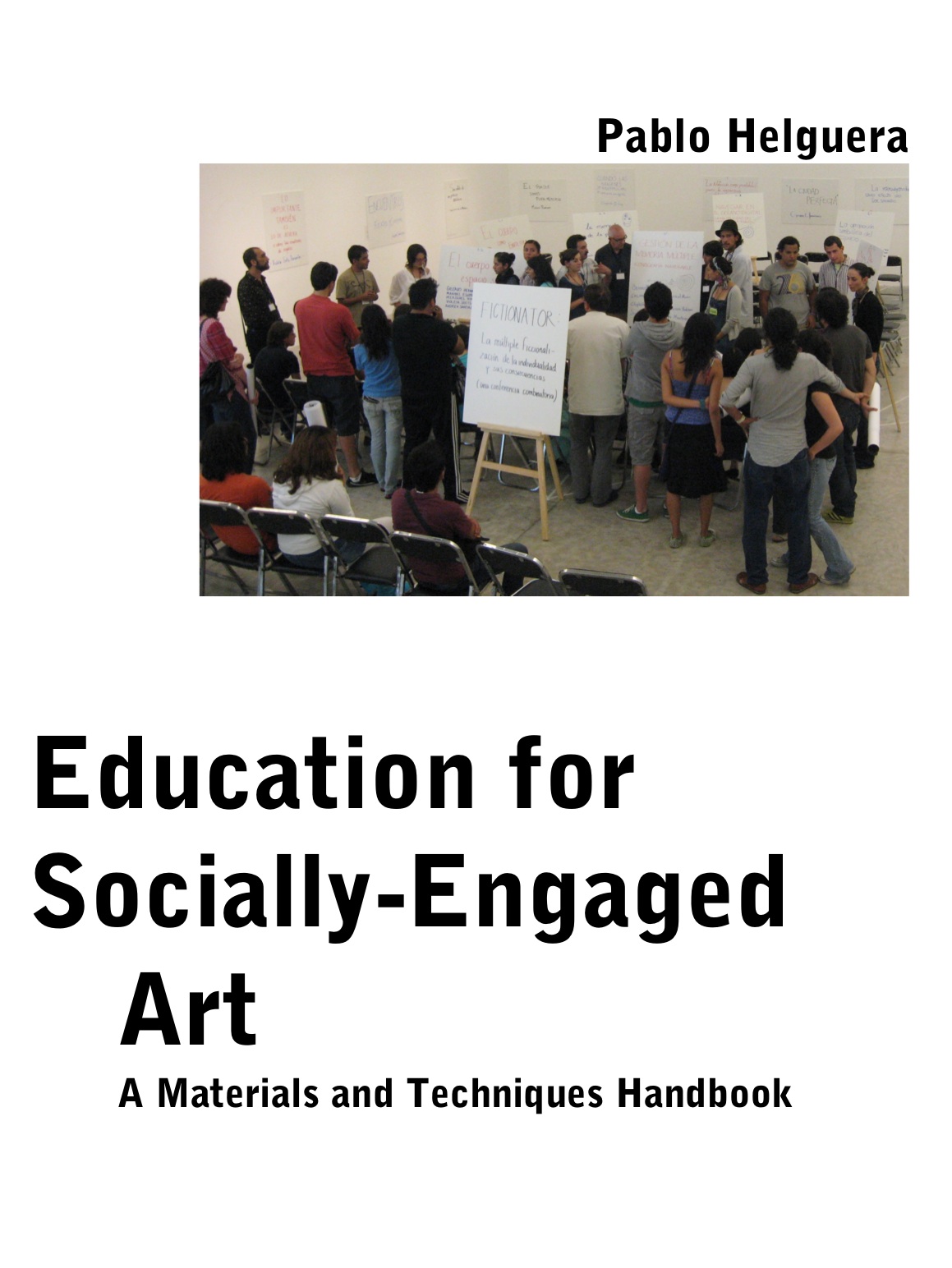
Inspiring Referents and Liana links: Pablo Helguera new book Education for Socially Engaged Art
Education for Socially Engaged Art (2011)
11.22.2011 | Book Excerpts, Books, Education, Essays, Performance, Socially Engaged Art
Education for Socially Engaged Art is the first “Materials and Techniques” book for the emerging field of social practice. Written with a pragmatic, hands-on approach for university-level readers and those interested in real-life application of the theories and ideas around socially engaged art. The book, emphasizing the use of pedagogical strategies to address issues around social practice, addresses topics such as documentation, community engagement, dialogue and conversation, amongst many others.
The book was published by Jorge Pinto Books in 2011 and can be acquired online.
An interview on the subject can be found here:
http://www.artpractical.com/feature/interview_with_pablo_helguera/
–
“For too long Social Practice has been the notoriously flimsy flipside of market-based contemporary art: a world of hand-wringing practitioners easily satisfied with the feeling of ‘doing good’ in a community, and unaware that their quasi-activist, anti-formalist positions in fact have a long artistic heritage and can be critically dissected using the tools of art and theatre history. Helguera’s spunky primer promises to offer a much-needed critical compass for those adrift in the expanded social field.” -
—Claire Bishop, Professor of Contemporary Art and Exhibition History, CUNY, and author ofArtificial Hells: Participatory Art and the Politics of Spectatorship
“This is an extremely timely and thoughtful reference book. Drawn from empirical and extensive experience and research, it provides a curriculum and framework for thinking about the complexity of socially engaged practices. Locating the methodologies of this work in between disciplines, Helguera draws on histories of performance, pedagogy, sociology, ethnography, linguistics, community and public practices. Rather than propose a system he exposes the temporalities necessary to make these situations possible and resonant. This is a tool that will allow us to consider the difficulties of making socially engaged art and move closer to finding a language through which we can represent and discuss its impact.”
—Sally Tallant, Artistic Director, Liverpool Biennial
“Helguera has produced a highly readable book that absolutely needs to be in the back pocket of anyone interested in teaching or learning about socially engaged art”
—Tom Finkelpearl, Director of the Queens Museum, New York, and author of Dialogues in Public Art
Monday, 24 October 2011
MDM at Escuela de Calor
"There is an abc-ignorance that precedes knowledge, and there is another learned ignorance that comes after and that is created through 'knowing' and that will equally like the first be annihilated and annulled by knowledge."
Michel de Montaigne [1]
Lord Michel Eyquem de Montaigne (French pronunciation: [miʃɛl ekɛm də mɔ̃tɛɲ]), February 28, 1533 – September 13, 1592, was one of the most influential writers of the French Renaissance, known for popularising the essay as a literary genre and is popularly thought of as the father of Modern Skepticism. He became famous for his effortless ability to merge serious intellectual speculation with casual anecdotes[2]and autobiography—and his massive volume Essais (translated literally as "Attempts") contains, to this day, some of the most widely influential essays ever written. Montaigne had a direct influence on writers the world over, including René Descartes,[3] Blaise Pascal, Jean-Jacques Rousseau, Ralph Waldo Emerson, Friedrich Nietzsche, Stefan Zweig, Eric Hoffer,[4] Isaac Asimov, and perhaps William Shakespeare (see "Influences" section below).
In his own time, Montaigne was admired more as a statesman than as an author. The tendency in his essays to digress into anecdotes and personal ruminations was seen as detrimental to proper style rather than as an innovation, and his declaration that, 'I am myself the matter of my book', was viewed by his contemporaries as self-indulgent. In time, however, Montaigne would be recognised as embodying, perhaps better than any other author of his time, the spirit of freely entertaining doubt which began to emerge at that time. He is most famously known for his skeptical remark, 'Que sais-je?' ('What do I know?'). Remarkably modern even to readers today, Montaigne's attempt to examine the world through the lens of the only thing he can depend on implicitly—his own judgment—makes him more accessible to modern readers than any other author of the Renaissance. Much of modern literary non-fiction has found inspiration in Montaigne and writers of all kinds continue to read him for his masterful balance of intellectual knowledge and personal story-telling.
"I enter into discussion and argument with great freedom and ease, inasmuch as opinion finds me in a bad soil to penetrate and take deep root in. No propositions astonish me, no belief offends me, whatever contrast it offers to my own. There is no fancy so frivolous and so extravagant that it does not seem to me quite suitable to the production of the human mind."
Monday, 10 October 2011
School of Heat warming Up!
On his book The Ignorant School Master , Ranciere states that universal teaching, the form of education which emancipates the individual, cannot be systematised or set within the status quo in any way - universal teaching cannot be that which is utilised by the various orders of society, and supported the finds of Joseph Jacotot, we also believe on this principles and we are working up for their defence
1 - All men have equal intelligence
2 - Every man has received from god the ability to instruct himself
3 - Everything is in everything
La misma inteligencia crea los nombres y crea los signos de las matemáticas. La misma inteligencia crea los signos y crea los razonamientos. No existen dos tipos de espíritu. Existen distintas manifestaciones de la inteligencia, según sea mayor o menor la energía que la voluntad comunique a la inteligencia para descubrir y combinar relaciones nuevas, pero no existen jerarquías en la capacidad intelectual. Es la toma de conciencia de esta igualdad de naturaleza la que se llama emancipación y la que abre la posibilidad a todo tipo de aventuras en el país del conocimiento. Ya que se trata de atreverse a aventurarse y no de aprender más o menos bien o más o menos rápido. El «método Jacotot» no es mejor, es otro. Ésta es la razón por la que los procedimientos puestos en juego importan poco por sí mismos."
El maestro ignorante. Jacques Ranciere . p.19
We are all here to speak about the virtue of masters. I wrote a work called The Ignorant Master. Therefore it falls to me to defend on this subject the most apparently unreasonable of positions: the first virtue of the master is that of ignorance. My book tells the history of a professor, Joseph Jacotot, who created a scandal in the Holland and France of the 1830s by proclaiming that uneducated people could learn on their own without a master to explain things to them, and that masters, on their side, could teach the things they themselves did not know. To the suspicion of trading in facile paradoxes we thus add that of being content with the cliches and extravagances of the history of pedagogy.
I would like however to show that what we are dealing with here is not the pleasure of paradox but a fundamental examination of the meaning of knowing, teaching and learning; that this is not merely an amusing journey into the history of pedagogy but a philosophical reflection, entirely up-to-date, on the manner in which pedagogical reason and social reason hold together.
I will immediately go to the heart of the question. What is this virtue of ignorance? What is an ignorant master? In order to respond well to this question we have to distinguish between several different levels. On the most immediate, empirical level, an ignorant master is one who teaches things he does not know. It is thus that Joseph Jacotot found himself suddenly teaching Flemish students with whom he did not share a language through the intermediary of a providential book, a bilingual edition of Homer published at that time in the Low Countries. He placed himself in his students' hands and told them, through an interpreter, to read half of the book with the aid of the translation, to repeat constantly what they had learned, to quickly read the other half and then to write in French what they thought about it. He was astonished, it is said, to see how these students, to whom he had not transmitted any knowledge, had learned, on his order, enough French to express themselves very passably, how he had thus educated them without having taught them anything. He concluded that the act of a master who obliges an other intelligence to exercise itself is independent of that master's possession of knowledge - that it was thus possible that an ignorant person might enable another ignorant person to know that which he did not himself know, that a common illiterate man might teach another illiterate to read.
We come there to the second level of the question, the second meaning of "ignorant master": an ignorant master is not just an ignorant person who gets a kick out of playing master. It is a master who teaches - that's to say, who is for another person a cause of knowledge - without transmitting any knowledge. A master, thus, who displays the discontinuity between the master's control and his knowledge, who shows us that what is called "the transmission of knowledge" consists in fact of two intertwined relations which it is useful to disassociate: a relation of will to will and one of intelligence to intelligence. But we must not be mistaken about the meaning of this disassociation. There is a common way of understanding it: an attempt to weaken the relationship of magisterial authority in order to enhance the simple force of one intelligence enlightening another. This is the principle of so many anti-authoritarian pedagogies whose model is the Socratic method, that of the master who feigns ignorance in order to provoke knowlege. But the ignorant master makes a very different kind of disassociation. He understands, in fact, the double bluff of the Socratic method. Under the appearance of nurturing a capability it aims in fact at demonstrating an incapability. Socrates does not only show the incapability of false savants but also the incapability of whoever is not led by the master along the correct route, in conformity with the correct relationship of intelligence to intelligence. The "liberalism" of the Socratic method is really only a sophisticated variation on ordinary pedagogical practice which confers on the master's intelligence the responsibility for overcoming the distance that separates the ignorant person from knowledge. Jacotot inverts this disassociation: the ignorant master exercises no relation of intelligence to intelligence. He is simply an authority, simply a will that instructs the ignorant person to set out on a path, that's to say to activate the capability that he already possesses, the capacity that every human being has demonstrated in succeeding with a master at the most difficult of apprenticeships: that of learning that foreign language that for every child entering the world is the language that we call their "mother tongue."
This is actually the lesson we learn from the stroke of chance that turned the learned master Jacotot an ignorant master. The lesson has to do with the very logic of pedagogical reason, which is to teach the ignorant person that which he does not know, to suppress the distance between the ignorant person and knowledge. The usual mechanism is explanation. To explain is to lay out the elements of the knowledge that must be transmitted in a manner appropriate to the supposedly limited capacity of the minds under instruction. But this idea, apparently so simple, of the "appropriate manner", is clearly subject to an infinite regression. Explanation is generally accompanied by an explanation of the explanation. There must be books to explain to those who do not know the knowledge they must acquire. But this explanation is apparently insufficient: there must also be masters to explain to them the books that are explaining the knowledge. There must be explanations so that the ignorant person understands the explanation that permits him to understand. The regression is actually infinite while the authority of the master is still accepted as the sole judge of the point where explanations have no need of further explanations.
Jacotot believed he could find the logic for this apparent paradox. If explanation is in fact infinite, it is because its essential function is to make infinite that very distance that it attempts to reduce. The practice of explanation is not at all a practical procedure in pursuit of an end. It is an end in itself, the infinite verfication of a basic axiom: the axiom of inequality. To explain something to an ignorant person is first of all to explain to him that he would never understand if things were not explained to him; it is first of all to explain to him his own incapability. Explanation offers itself as a method of reducing the situation of inequality that such people find themselves in with regard to those who know. But this reduction is, for all that, a confirmation. To explain is to grant to the matter that must be learned a specific kind of opacity, an opacity that cannot be penetrated by those kinds of interpretation and imitation by which an infant learns to translate the signs that he receives from the world and from the speaking beings around him.
This is the specific inequality that ordinary pedagogical thought displays to us. This display has three specific features. First, it supposes a radical distinction between two types of intelligence: the empirical intelligence, on the one hand, of speaking beings who talk to each other and intuit each other's meaning, and, on the other, the systematic intelligence of those who comprehend things according to their own inherent articulations: histories, for children and for popular minds, and reasons, for rational minds. Teaching therefore comes to seem like a radical point of departure, a second birth, the moment where it is no longer a question of speaking and intuition but of explaining and comprehension. Its primodial act is to divide intelligence into two, to exile from the habits of those who do not know all the procedures by which their minds have learned everything up till that point.
From this the second feature. Pedagogical reason presents itself as the act which lifts the veil from the obscurity of things. Its topography is that of summit and base, of surface and depth. The person who can explain things is the one who brings the dark depths up to the illumination of the surface and who, conversely, discredits the false appearance of the surface in favour of the secret depths which contain its truth. This verticality opposes the depth of the learned order of reason to the horizontal method of the self-taught apprenticeship which moves from one thing to something adjacent, comparing what it does not know to what it knows.
Thirdly, this topography also implies a certain temporality. To lift the veil from things, to relate every surface to its depth and to bring every depth to the surface - all this does not require only time. It assumes a certain temporal order. The veil is lifted gradually, according to the level of capability of the ignorant or infant spirit at any given point. In other words, progress is always the flip-side of the delay that comes from the pupil's inadequacy. The reduction of distance never ceases therefore to reinstate and to prove the axiom of inequality.
Ordinary pedagogical reason is based on two fundamental axioms: first, it is necessary to begin with inequality in order to reduce it; second, the method of reducing inequality is to conform to it by making the objective a form of knowledge. The success of the knowledge that reduces inequality comes from the knowledge of inequality.
It is this "knowledge" that the ignorant master refuses. This is the third sense of his ignorance. This is the ignorance of this "knowledge of inequality" which is supposed to set the terms for the reduction of inequality. About inequality, there is nothing to know. Inequality is no more a fact that must be transformed by knowledge than equality is a goal that can be attained through the transmission of knowledge. Equality and inequality are not two states but two "opinions" - that is, two opposing axioms according to which the apprenticeship can operate, two axioms that allow no passage between them. All that one can do is to prove the axiom that one has given oneself. The reason of the master as he explains makes inequality an axiom: there is inequality between minds but we can make use of this very inequality, to make of it the cause of a future equality. The master is the superior being who works towards the abolition of his own privilege. The art of the master who methodically lifts the veil from the things that ignorant people could never understand on their own promises that one day they will be their master's equal. FOr Jacotot this future equality consists simply of the fact that the unequal who has become equal will himself then drive the system that produces and reproduces inequality by reproducing the process of its reduction. The overall logic of this process that works under the presupposition of inequality, for Jacotot deserves the name: brutalization.
The reason of the ignorant master poses equality as an axiom to be verified. It relates the inequality of the master-pupil relationship not to an equality to come - and that will never come - but to the effectiveness of a basic equality: in order that the ignorant person can perform the exercises given to him by his master, he must already be able to understand what the master says. There is an equality between the speaking beings that precedes the relationship of inequality and sets the terms for how it may be exercised. It is this that Jacotot calls the equality of intelligences. This does not mean that all exercise of all intelligence is the same. It means that there is only one form of intelligence at work in all intellectual apprenticeships.
The ignorant master - that is to say, the master ignorant of inequality - thus addresses himself to the "ignorant person" from the point of view not of his ignorance but of his knowledge, for he already in fact knows many things. he has learned them by listening and repeating, by observing and comparing, by guessing and verifying. It is thus that he has learned his mother tongue. It is thus that he can learn how to write, for example by comparising a prayer that he knows by heart to the unknown patterns that are formed oon paper by the written text of the same prayer. He must be obliged to relate what he does not know to what he knows, to observe and compare, to tell what he has seen and to verify what he has said. If he does not give himself to such a challenge, it is because he things it is not possible or necessary for him to know more. The obstacle that the ignorant person faces to the exercise of his capaciies is not his ignorance but his consent to ignorance. He is residing in the opinion of inequality held by intelligence.
But this opinion is quite different from an individual mental retardation. It is an axiom of the system, it is the axiom under which the social system ordinarily functions: the axiom of inequality. He who does not wish to proceed further in the development of his intellectual power satisfies himself with being "unable" to do so thanks to the reassurance that others cannot do so any more than he. The axiom of inequality is an axiom that compensates for the inequalities that operate in the rest of society in general. It is not the master's knowledge that can suspend the functioning of this machine of inequality, but his will. The command of the emancipating master forbids the so-called "ignorant" person from being satisfied with what he knows by declaring himself incapable of knowing more. It forces him to prove his capacity, to continue his intellectual adventure according to the same methods by which he began. This logic, which operates under the presupposition of equality and which demands its proof, is what we might call intellectual emancipation.
The opposition between "brutalization" and "emancipation" is not one between different methods of instruction. It is not an opposition between traditional or authoritarian methods and those that are new and participatory. Brutalization can and does operate through all sorts of modern, active learning systems. The opposition is properly one of philosophy. It concerns the idea of that intelligence that presides over the very idea of apprenticeship. The axiom of the equality of intelligences does not affirm any specific virtue of ignorant people, no knowledge of the humble or intelligence of the masses. It affirms simply that there is only one single sort of intelligence at work in all intellectual apprenticeships. It is in every situation a question of relating that which is not known to that which is known, of observing and comparing, of saying and verifying. The pupil is always a researcher. And the master is primarily a man who speaks to another, who tells stories and brings the authoriy of knowledge back to the poetic condition of all transmission of words. The philosophical opposition thus understood is, at the same time, a political opposition. Not because it would seek to denounce knowledge-from-on-high in the name of an intelligence-from-below. But in this much more radical way: because it concerns our very conception of the relationship between equality and inequality.
It is in fact the very logic of the normal relationship between these terms that Jacotot questions when he denounces the paradigm of explanation by showing the the explanatory logic is a social logic, a way in which the social order is represented and reproduced. If this story of the 1830s is directly relevant to us, it is because it si an exemplary response to the establishment, at that time, of a political and social system previously unknown: a system where inequality is no longer supposed to emerge from a sovereign or divine reality, where it has in fact no basis other than itself. A system, in sum, of the "immanentization" and, if we can say this, the equalization, of inequality.
The years of the Jacotot's polemic correspond in fact to the moment when the project of a reconstituted social order is finally put in place after the great upheaval of the French revolution. It is the moment when the revolution was supposed to be accomplished, in all the senses of the word, to pass from the age of critique, with its destruction of all monarchical and divine transcendences, to the "organic" age of a society built on its own immanent reason. This means a society putting in harmony its productive forces, its institutions and its beliefs, making them function according to a single, commonly-held regime of rationality. This is the grand project that occupies the nineteenth century - understood not simply as a break with the past but as a historic endeavour. The transition from the "critical" and revolutonary age to the organic age is most of all about the control of the relationship between equality and inequality. It is necessary, said Aristotle, to "reveal democracy to the democrats and oligarchy to the oligarchs." The project of the modern, organic society is the project of an unequal order which reveals its equality, which makes equality visible through its regulation of the relations between economic power and beliefs and institutions. This is the project of the "mediations" which institute between the top and bottom of society two essential things: a minimum web of commonly-held beliefs, and the possibility of separating, at least in a limited way, the level of an individual's wealth and the level of his power.
At the heart of this project is the programme of the "people's instruction", one that proceeds not only from the organisation of the state via the mechanism of public education, but also through the multiplicity of philanthropic, commercial or community initiatives that are devoted to a double task: on the one hand to develop "useful knowledge" - the forms of practical, rationalised knowledge that will enable people to emerge from their drudgery and improve their living conditions without having either to leave behind their condition or to make other claims; on the other hand to enoble the life of the people by making it part, in the appropriate forms, of the pleasures of art and the expression of a community sentiment: the "aesthetic" education of the people for which the founding of choral societies provides the great model.
The vision of the collective that animates these various public and private initiatives is clear: it seeks to achieve three effects. First, to pull people from the retrogressive practices and beliefs that hold them back from participating in the progress of wealth and that encourage in them various forms of resentment against the commanding elites; secondly to build between the elites and the people a minimum level of beliefs and communal joys that will avoid the prospect of a society divided into two separate, and potentially hostile, words; and third, to assure a minimum of social mobility which creates a general feeling of improvement and allows the most talented of the children of the people to climb the social ladder and to refresh the ranks of the elite.
Conceived in this way, the instruction of the people is not simply an instrument, a practical method of working towards the reinforcement of social cohesion. It is, more properly, an "explanation" of society, an allegory of the way in which inequality is reproduced through the "making visible" of equality. This "making visible" is not a simple illusion; it is part of the reality that I call a "distribution of the sensible": a global relation between the ways of being, the ways of doing, seeing and doing. It is the two-faced visiblity of this inequality: inequality appplied to the work of its own suppression, proving by its own actions the simultaneously incessant and unending nature of this suppression. Inequality does not hide itself under equality. It affirms its own equality with it. This equality of equality andquality has a proper name. It is called "progress". The modern organic society that applies itself to the task of "accomplishing" the revolution places in opposition to the static order of ancient societies a "progressive" order, an order identical to mobility itself, to the movement of the expansion, transmission and application of different kinds of knowledge.
The School is not merely the vehicle of the new progressive order. It is in fact its very model: the model of an inequality identified by the visible difference between those who know and those who do not, and that devotes itself visibly to the task of making ignorant people learn what they do not know and thus of reducing inequality - but of reducing it in stages according to the correct methods that only the elites understand: the methods that give to a given population, at the right moment, that knowledge it is capable of usefully assimilating. Educational progress is also the art of limiting the transmission of knowledge, to manage the delay, to postpone equality. The pedagogical paradigm of the master who explains, adapting himself to the capacity and the needs of his pupils, defines the social functioning of the school that is also the model for a society living under the order of progress.
The ignorant master is the master who removes himself from this game, by opposing the bare act of intellectual emancipation to the mechanism of society and of progressive institutions. Placing intellectual emancipation in opposition to the institution of the people's instruction is to assert that there are no stages to equality, that equality is wholly present, or is not at all. The price of this opting out is heavy: if explanation is the social method, the method by which inequality represents itself and reproduces itself, and if the institution is the place where this representation takes place, it follows that intellectual emancipation is necessarily opposed to the logic of society and its institutions. This does not mean that there is no social emancipation or emancipatory education. Jacotot sees the method of emancipation, which is the method of individuals, as being thoroughly opposed to the social method of explanation. Society is a mechanism governed by the weight of forces lined up against equality, a mechanism governed by the game of compensated inequalities. And all that emancipation can promise is to teach people to be equal in a society governed by inequality and by the institutions that "explain" it.
This extreme paradox deserves to be taken seriously. It alerts us to two essential things. First: equality, in general, is not a goal to be reached. It is a point of departure, a presupposition that must be proved by sequences of specific acts. Second: equality is the condition of inequality itself. In order to obey an order, one must understand it, and understand that it must be obeyed. There must therefore be this minimum of equality, without which inequality would turn in the void. From these two axioms, Jacotot drew a radical disassociation: emancipation could never be a social logic. I tried to show in my book "Disagreement" that they could be articulated differently, that the egalitarian condition of inequality could lend itself to series of acts, to forms of verification that were properly political. But this demonstration does not come into the frame of the question that brings us here today. I will apply myself therefore to another aspect of the problem: how can we think today about this relationship between pedagogical reason and social reason that Jacotot had placed at the heart of his argument?
At first sight, this relationships presents itself today in the form of a strange dialectic. On the one hand, the School is always in the situation of acknowledging that it has failed in its task to reduce social inequalities. But on the other, this school, constantly declared inadequate to its social function, appears more and more as an adequate model for "egalitarian" functioning - that's to say for the "unequal equality" proper to our societies.
I will begin, in order to illustrate this dialectic, with the debate on educational equality and inequality, as it has grown up in Francesince the 60s, because the terms of the debate seem to me to sum up fairly well a problem that we find more or less everywhere in the same terms. The debate was launched by Bourdieu's thesis, that we can summarize thus: The School fails in the mission of reducing inequality that has been set for it because it is ignorant of the functioning of inequality. It pretends to reduce inequality by distributing the same knowledge to all, equally. But it is precisely in this egalitarian appearance that we find the essential engine of the reproduction of educational inequality. It assumes that the notion of "individual talent" can do all the work of explaining the differences between students. But this "talent" is itself only the interiorized cultural privilege of well-born children. The children fom this class do not wish to know this, while the children of the dominated classes are not able to know this and thus eliminate themselves by the painful awareness of their absence of talent. The School fails to bring about equality because the egalitarian appearance of things hides the transformation of socially inherited cultural capital into individual difference.
The School, according to this logic, functions unequally because it does not understand how inequality itself functions - because it does not wish to know. But this "refusal to know" can be interpreted in two ways that are the exact opposite of each other. It can be understood as the ignorance of the conditions for the transformation of inequality into equality. In this case we would say that the master misunderstands the conditions of his practice because he lacks a certain form of knowledge, the knowledge of inequality - knowledge that he could learn from the sociologist. We would then conclude that educational inequality can be cured at the cost of an extra acquisition of knowledge that makes the rules of the game expliciity and rationalizes the system of school education. This was the conclusion reached by Bourdieu and Passeron in their first book together, "The Inheriters".
But the refusal to know may also be understood as the successful interiorization of the logic of the system: we would say in this case that the master is the agent of a process of the reproduction of cultural capital which, through a necessity inherent to the very functioning of the social machinery, reproduces indefinitely its conditions of possibility. Every programme of reform will thus be charged with futility from the very outset. It's with this feeling that Bourdieu and Passeron's next book, Reproduction, ends.
The "refusal to know" is therefore ambiguous. It leads us on the one hand towards the reduction of inequality, and on the other towards their eternal continuation. But this ambiguity is merely the ambiguity of "progressivism" itself, as Jacotot initially analysed it: it is the logic of the inequality that is reproduced by the very effort to reduce it. The sociologist merely introduces an extra circle to the spiral by adding to it a certain ignorance, a supplementary incapacity: the ignorance of that which can destroy ignorance.
Governmental reformers are determined not to see this ambiguity essential to all progressivist pedagogies. Socialist reformers therefore drew out of Bourdieu's sociology a programme aiming to reduce the inequalities of the School by reducing the presence there of grand culture, by making the place less learned and more convivial, better adapted to the habits of children from unfavourable backgrounds - that's to say, for the most part, children from immigrant families. Unfortunately, this cut-down version of Bourdieu only affirmed all the more strongly the centrality of the progressivist premise that obliges he who knows to place himself "within reach" of those who do not, to limit transmitted knowledge only to that which the poor can understand and of which they have need. It reproduces the process that confirms present inequality in the name of the equality that will come.
This is why this intervention quickly led to a backlash. In France the ideology we think of as Republican was quick to denounce these methods that were designed for the poor and that could only ever be the methods of the poor, burying the "dominated" from the outset still deeper in the situation from which they pretended to extricate them. The power of equality resided for this Republican world-view rather in the universality of a knowledge equally distributed to everyone, without consideration of social origin, in the idea of a School completely removed from society. But the distribution of knowledge does not lead of itself to any egalitarian consequence for the social order. Equality and inequality are only ever the consequence of themselves. The traditional pedagogy, consisting of the neutral transmission of knowledge, and the modern pedagogies, in which knowledge is adapted to the state of society, both lie on the same side of the dialectic posed by Jacotot. Both of them take equality as their goal, which is to say that they take inequality as a point of departure and operate under its premise. They diverge only on the particular kind of "knowledge of inequality" that they presuppose.
This is to say that both of these are shut up in the circle of the "pedagogized society." Both attribute to the School the fantasmatic power of bringing about social equality or, at least, of reducing "social fragmentation" even as they both denounce the failure of the other to realize such a programme. The sociologists call this failure the "crisis of schools" and appeal for the educational reform. The Republicans identify reform itself as the principal cause of the crisis. But reform and crisis can be brought together under one single notion of Jacotot: both of them are the explanation of the School, the infinite explanation of the reasons why inequality must lead to equality and yet never does so. Crisis and reform are in fact the normal functioning of the system, the normal functioning of the "equalized" inequality in which pedagogical reason and social reason become more and more like each other.
It is in fact remarkable that this School that is declared incapable of "reducing" inequality presents itself more and more as the positive analogy of the social system. In this sense we can say that Jacotot's diagnosis of pedagogical reason as a new, generalized form of inequality has been perfectly vindicated. Jacotot had discerned, in the role that the "progressive" spirits of his time granted to the instruction of the people, the premise of a new form of the "distribution of the sensible", of an identification between pedagogical reason and social reason. He had discerned this in the heart of a society for which such an identification was still only a utopia, where the value and the persistence of class divisions and of hierarches were enthusiastically asserted by elites, where inequality was affirmed as the legitimate law of the community's functioning. He wrote at the time when recalled along with their thinker Bonald that certain people were "in" society without being "of" society and when liberals explained in the words of their spokesperson, the Minister François Guizot , that politics was the business of "men of leisure." The elites of his time admitted without embarassment inequality and class division. The instruction of the people was only, for them, a way of creating some mediations between the top and bottom of society: to give to the poor the possibility of individually improving their condition and to give to everyone the feeling of belonging, each one in his place, to the same community.
We are clearly not in this situation anymore: our societies present themselves as homogeneous places where the lively, inclusive rhythm of the multiplication of commodities and of exchange has levelled out the old class divisions and allows everyone to participate in the same pleasures and liberties. In such conditions the representation of social inequalities tends to operate more and more on the model of educational achievement: everyone is equal and has the potential to reach any position. No more proletarians, only newcomers who have not yet taken on the rhythm of modenity - or else the laggards who, conversely, are no longer able to keep up with its accelerations.
Everyone ie equal but certain people lack the intelligence or the necessary energy for withstanding competition or simply for assimilating the new exercises that rushing Time, the great teacher, imposes on them each year. They cannot adapt, we say, to new technologies and mindsets and remain trapped between the depths of class and the abyss of "exclusion." Society represents itself thus as a vast school with its savages that must be civilized and its backward pupils who are having problems keeping up. In these conditions the school is increasingly charged with the miraculous task of overcoming the divide between the vaunted equality of conditions and the actual inequality, increasingly expected to reduce this inequality that is understood to be merely residual.
But the ultimate effect of such over-inflated expectations of the school is, paradoxically, to pander to an oligarchical vision of a society-school. Not only are the authority of the state and economic power both subsumed within this image of the school, but it is a school presented as if without schoolmasters, where the masters are merely the best in the class, those who adapt the best to progress and show themselves capable of synthesizing all the facts that are too complex for ordinary intelligences. To these "first in the class" is proposed, once again, the old pedagogical choice that has become global social reason: the austere Republicans ask them to manage with the authority and the distance indispensable for the good progress of the class, the interests of the community; the sociologists, political theorists or journalists ask them to adapt themselves, by good communicative pedagogy, to the needs of modest minds and to the daily problems of the least able, in order to help the slowest to advance themselves, the excluded to integrate themselves, and the social fabric to heal.
Expertise and journalism are the two great intellectual institutions charged with supporting the government of the elder brothers or the "first in the class" by making this unprecedented form of the social bond circulate indefatigably, this perfected explanation of inequality that structures our societies: the knowledge of the reasons why the drop-outs are drop-outs. It is in this way, for example that every dissenting demonstration - from social movements from the extreme left or extreme right - brings with it a fury of attempts to explain the reasons for the persistence of these old, savage forms - archaic trades unionists, little savages brought in through immigration, or middle-class families left behind by the speed of progress. According to the good brutalizing logic, this explanation is reinforced by the explanation of how we can lift these left-behind people out of their savagery, a list of methods that is unfortunately rendered improbable by the very existence of these left-behind people. If t cannot bring them out of their condition, such an explanation does on the other hand do a good job of rationalizing the power of those who lead the class, a power that consists entirely in this "advancement" over those "left behind."
It is precisely this that Jacotot had in mind: the manner in which the School and society inter-symbolise each other endlessly, and thus reproduce indefinitely the presupposition of inequality, in the very act of denying it. If I have felt it appropriate to revive this discourse that had fallen into oblivion, it is therefore not, again, to propose a new pedagogy. There is no "Jacotist" pedagogy. Nor is there a Jacotist anti-pedagogy in the sense that we usually give to that word. In brief Jacotot's programme is not one of pedagogical thought that one could use to reform the educational system. The virtue of ignorance is first of all a virtue of dissociation. By commanding us to dissociate control [maîtrise - the attribute of the master] and knowledge, it becomes useless as the basis of any institution where these two things would come together in harmony in order to optimise the social function of the institution. It is precisely against this desire to harmonize and optimize that the critique is levelled. This critique does not forbid us to teach, it does not forbid the function of the master. It requires us rather to separate radically the power of being for whatever cause of knowledge and the idea of a global social function for the institution that is aimed at bringing about equality.
Equality, according to Jacotot, only exists in the act and for individuals. It is lost as soon as it is imagined in a collective way. It is possible to correct this conclusion, to think about the posibility of collective realizations of equality. But this very possibility presupposes that we keep separate the forms of actualizing equality, that we refuse in consequence the idea of an institutional mediation, of a social mediation, between individual manifestations and collective manifestations of equality. Certainly, individual and collective actualizations have the same presupposition: the presupposition that equality is in the last instance the condition of possibility of inequality ittself and that i is possible to bring some effectiveness out of this condition. There is therefore an analogy between the effects of the egalitarian axiom, as there is an analogy between the effects of the axiom of inequality. But this latter functions as an effective social mediation. It is this uninterrupted mediation that Jacotot theorises in the concept of explanation. But it is not the same for the analogy of equality. The act which emancipates an intelligence is on its own without any social effect. And the axiom of equality iself commands us to refuse the idea of such a mediation. It forbids us from thinking of a social reason through which individual actualizations could transform themselves into collective actualizations.
It is in effect thus that the reasons for inequality introduce themselves into the reasons for equality. The explaining and explained society, the society of equalized inequality, demands the harmonisation of its functions. It demands in particular of the teachers that we combine our expertise as learned researchers, our function of masters working in an institution and our activity as citizens into one sole energy that works together towards the transmission of knowledge, social integration and social conscience. It is this quest that the virtue of the "Ignorant master" commands us to be ignorant of. The virtue of the ignorant master is to know that an educated person is not a master, that a maser is not a citizen, that a citizen is not an educated person. Not that it is not possible to be these three at the same time. It's that it is nevertheless impossible to harmonize the roles of these three personalities. This harmanization only ever achieves itself in the sense of the dominant explanation. The philosophy of emancipation demands the division of different kinds of reason. It showsus that it is possible to make the social machine function whilst still working, if we wish it, towards the invention of individual or collective actualizations of equality - but that these functions can never become condused. It demands that we refuse the mediatisation of equality.
This is, it seems to me, the lesson that we can draw from this singular dissonance asserted at the very beginning of the functioning of the modern educational-social machine. Equality only inscribes itself in the social machine by disagreement. Disagreement is not primarily about argument, it is the division in the very configuration of sensible facts, the disassociation introduced into the correspondence between ways of being and ways of doing, seeing and saying. Equality is simultaneously the final principle of every social and governmental order and the silent cause of its "normal" functioning. It does not reside either in a system of constitutional forms or in a the state of a society's mores, or in the homogeneous education of the Republic's children or in the availability of low-priced products on the shelves of supermarkets. Equality is fundamental and absent, it is current and out of place, always subject to the initiative of those individuals and groups who, counter to the ordinary course of things, take the risk of proving it - of inventing the forms, individual or collective, of its verification. The assertion of these simple principles constitutes in fact an unheart-of dissonance, a dissonance that we have to in some way forget in order to continue to build schools, programmes and pedagogies, but that we must also, from time to time, hear again in order that the act of teaching not lose its conscience of the paradoxes that give it sense.
Subscribe to:
Posts (Atom)